youtube facebook twitter linkedin
the book of earth. Powered by Blogger.

Pages

  • Home

The book of earth


For other uses, see Centipede (disambiguation).
Centipedes (from Latin prefix centi-, "hundred", and pes, pedis, "foot") are arthropods belonging to the class Chilopoda of the subphylum Myriapoda. They are elongated metameric creatures with one pair of legs per body segment. Centipedes are known to be highly venomous, and often inject paralyzing venom. Despite the name, centipedes can have a varying number of legs, ranging from 30 to 354. Centipedes always have an odd number of pairs of legs. Therefore, no centipede has exactly 100 legs. A key trait uniting this group is a pair of venom claws or forcipules formed from a modified first appendage. Centipedes are predominantly carnivorous.:168

Their size can range from a few millimetres in the smaller lithobiomorphs and geophilomorphs to about 30 cm (12 in) in the largest scolopendromorphs. Centipedes can be found in a wide variety of environments. They normally have a drab coloration combining shades of brown and red. Cavernicolous (cave-dwelling) and subterranean species may lack pigmentation, and many tropical scolopendromorphs have bright aposematic colours.

Worldwide, an estimated 8,000 species of centipedes are thought to exist, of which 3,000 have been described. Centipedes have a wide geographical range, where they even reach beyond the Arctic Circle. They are found in an array of terrestrial habitats from tropical rainforests to deserts. Within these habitats, centipedes require a moist microhabitat because they lack the waxy cuticle of insects and arachnids, therefore causing them to rapidly lose water. Accordingly, they are found in soil and leaf litter, under stones and dead wood, and inside logs. Centipedes are among the largest terrestrial invertebrate predators, and often contribute significantly to the invertebrate predatory biomass in terrestrial ecosystems. Only one species, Scolopendra cataracta, is known to be amphibious and is believed to hunt aquatic or amphibious invertebrates.

Description

Underside of Scolopendra cingulata, showing the forcipules

Close-up of the tail-like rear pair of legs of a centipede
Centipedes have a rounded or flattened head, bearing a pair of antennae at the forward margin. They have a pair of elongated mandibles, and two pairs of maxillae. The first pair of maxillae form the lower lip, and bear short palps. The first pair of limbs stretch forward from the body to cover the remainder of the mouth. These limbs, or maxillipeds, end in sharp claws and include venom glands that help the animal to kill or paralyze its prey.

Many species of centipedes lack eyes, but some possess a variable number of ocelli, which are sometimes clustered together to form true compound eyes. However, these eyes are only capable of discerning light and dark, and have no true vision. In some species, the first pair of legs at the head end of the centipede acts as sense organs similar to antennae, but unlike the antennae of most other animals, theirs point backwards. Unusual sense organs found in some groups are the organs of Tömösváry. These are located at the base of the antennae, and consist of a disc-like structure with a central pore surrounded by sensory cells. They are probably used for sensing vibrations, and may even provide a sense of hearing.

Forcipules are a unique feature found only in centipedes and in no other arthropods. The forcipules are modifications of the first pair of legs, forming a pincer-like appendage always found just behind the head. Forcipules are not true mouthparts, although they are used in the capture of prey items, injecting venom and holding onto captured prey. Venom glands run through a tube almost to the tip of each forcipule.


Behind the head, the body consists of 15 or more segments. Most of the segments bear a single pair of legs, with the maxillipeds projecting forward from the first body segment, and the final two segments being small and legless. Each pair of legs is slightly longer than the pair immediately in front of it, ensuring that they do not overlap, so reducing the chance that they will collide with each other while moving swiftly. In extreme cases, the last pair of legs may be twice the length of the first pair. The final segment bears a telson and includes the openings of the reproductive organs.

As predators, centipedes mainly use their antennae to seek out their prey. The digestive tract forms a simple tube, with digestive glands attached to the mouthparts. Like insects, centipedes breathe through a tracheal system, typically with a single opening, or spiracle on each body segment. They excrete waste through a single pair of malpighian tubules.

Scolopendra gigantea, also known as the Amazonian giant centipede, is the largest existing species of centipede in the world, reaching over 30 cm (12 in) in length. It is known to eat lizards, frogs, birds, mice, and even bats, catching them in midflight, as well as rodents and spiders.

Lifecycle

A centipede protecting her eggmass
Centipede reproduction does not involve copulation. Males deposit a spermatophore for the female to take up. In one clade, this spermatophore is deposited in a web, and the male undertakes a courtship dance to encourage the female to engulf his sperm. In other cases, the males just leave them for the females to find. In temperate areas, egg laying occurs in spring and summer, but in subtropical and tropical areas, little seasonality to centipede breeding is apparent. A few species of parthenogenetic centipedes are known.

The Lithobiomorpha and Scutigeromorpha lay their eggs singly in holes in the soil, and the female fills the holes with soil and leaves them. The number of eggs laid ranges from about 10 to 50. Time of development of the embryo to hatching is highly variable and may take from one to a few months. Time of development to reproductive period is highly variable within and among species. For example, it can take 3 years for S. coleoptrata to achieve adulthood, whereas under the right conditions, lithiobiomorph species may reach a reproductive period in 1 year. In addition, centipedes are relatively long-lived when compared to insects. For example: the European Lithobius forficatus can live for 5 or 6 years. The combination of a small number of eggs laid, long gestation period, and long time of development to reproduction has led authors to label lithobiomorph centipedes as K-selected.

Females of the Geophilomorpha and Scolopendromorpha show far more parental care. The eggs, 15 to 60 in number, are laid in a nest in the soil or in rotten wood. The female stays with the eggs, guarding and licking them to protect them from fungi. The female in some species stays with the young after they have hatched, guarding them until they are ready to leave. If disturbed, the female either abandons the eggs or eats them; abandoned eggs tend to fall prey to fungi rapidly. Some species of Scolopendromorpha are matriphagic, meaning the offspring eat their mother.

Little is known of the life history of the Craterostigmomorpha.

Centipedes grow their legs at different points in their development. In the primitive condition, exhibited by the lithobiomorphs, Scutigeromorpha, and Craterostigmomorpha, development is anamorphic: more pairs of legs are grown between moults. For example, Scutigera coleoptrata, the American house centipede, hatches with only four pairs of legs and in successive moults has 5, 7, 9, 11, 15, 15, 15 and 15 before becoming a sexually mature adult. Life stages with fewer than 15 pairs of legs are called larval stadia (about five stages). After the full complement of legs is achieved, the now postlarval stadia (about five stages) develop gonopods, sensory pores, more antennal segments, and more ocelli. All mature lithobiomorph centipedes have 15 leg-bearing segments.:27

The Craterostigmomorpha only have one phase of anamorphosis, with embryos having 12 pairs, and moultees 15.

The clade Epimorpha, consisting of the orders Geophilomorpha and Scolopendromorpha, exhibits epimorphy: all pairs of legs are developed in the embryonic stages, and offspring do not develop more legs between moults. This clade contains the longest centipedes; the maximum number of thoracic segments may also vary intraspecifically, often on a geographical basis; in most cases, females bear more legs than males. The number of leg-bearing segments varies widely, from 15 to 191, but the developmental mode of their creation means they are always added in pairs—hence the total number of pairs is always odd.

Ecology

A centipede being eaten by a European roller

Centipede seen on vegetation at Agumbe, Karnataka, India
Centipedes are predominantly generalist predators, which means they have adapted to eat a variety of different available prey. Examination of centipede gut contents suggests that plant material is an unimportant part of their diets, although centipedes have been observed to eat vegetable matter when starved during laboratory experiments.:168

Centipedes are mostly nocturnal. Studies on their activity rhythms confirm this, although a few observations of centipedes active during the day have been made, and one species, Strigamia chinophila, is diurnal. What centipedes actually eat is not well known because of their cryptic lifestyles and thorough mastication of food. Laboratory feeding trials support that they will feed as generalists, taking almost anything that is soft-bodied and in a reasonable size range. Earthworms may provide the bulk of diets for geophilomorphs, since they burrow through the soil and earthworm bodies would be easily pierced by their venom claws. Geophilomorphs probably cannot subdue earthworms larger than themselves, so smaller earthworms may be a substantial proportion of their diet.

Scolopendromorphs, given their size, are able to feed on vertebrates, in addition to invertebrates. They have been observed eating reptiles, amphibians, small mammals, bats, and birds. Springtails may provide a large proportion of lithiobiomorph diets. Little is known about scutigeromorph or craterostigmomorph diets. All centipedes are potential intraguild predators. Centipedes and spiders may frequently prey on one another.


Many larger animals prey upon centipedes, such as mongooses, mice, salamanders, beetles and snakes.:354–356 They form an important item of diet for many species and the staple diet of some such as the African ant Amblyopone pluto, which feeds solely on geophilomorph centipedes, and the South African Cape black-headed snake Aparallactus capensis.:354–356

Centipede defences include their speed and venomous forcipules, as well as the secretion of defensive chemicals. Geophilomorph centipedes can secrete sticky substances that generate toxic hydrogen cyanide and benzoic acid from microscopic glands on their undersides. Similarly, lithobiomorph centipedes secrete a sticky substance from glands in the rear-most two pairs of legs.

Water regulation is an important aspect of centipede ecology, since they lose water rapidly in dry conditions and are found in moist microhabitats. Water loss is a result of centipedes lacking a waxy covering of their exoskeleton and excreting waste nitrogen as ammonia, which requires extra water. Centipedes deal with water loss through a variety of adaptations. Geophilomorphs lose water less rapidly than lithobiomorphs, though they have a greater surface area to volume ratio. This may be because geophilomorphs have a more heavily sclerotized pleural membrane. Spiracle shape, size, and ability to constrict also have an influence on rate of water loss. In addition, the number and size of coxal pores may be variables affecting centipede water balance.

Centipedes live in many different habitat types—forest, savannah, prairie, and desert, to name a few. Some geophilomorphs are adapted to littoral habitats, where they feed on barnacles. Species of all orders excluding the Craterostigmomorpha have adapted to caves. Centipede densities have been recorded as high as 600/m2 and biomass as high as 500 mg/m2 wet weight. Small geophilomorphs attain highest densities, followed by small lithobiomorphs. Large lithobiomorphs attain densities of 20/m2. One study of scolopendromorphs records Scolopendra morsitans in a Nigerian savannah at a density of 0.16/m2 and a biomass of 140 mg/m2 wet weight.

Centipedes at Wangfujing market
Although unusual in most cultures as a food item, certain large-sized centipedes are consumed in China, usually skewered and grilled or deep fried. They are often seen in street vendor's stalls in large cities, including Donghuamen and Wangfujing markets in Beijing.

Also in China, as well as in Laos, Thailand, and Cambodia, large centipedes are kept in liquor for a period of time. This custom is allegedly part of the traditional Chinese medicine. Said to have medicinal properties and to be reinvigorating, the liquor with the centipede submerged in it is consumed as a special drink.

Main article: Centipede bite
Some species of centipedes can be hazardous to humans because of their bite. Although a bite to an adult human is usually very painful and may cause severe swelling, chills, fever, and weakness, it is unlikely to be fatal. Bites can be dangerous to small children and those with allergies to bee stings. The venomous bite of larger centipedes can induce anaphylactic shock in such people. Smaller centipedes are generally incapable of piercing human skin.

Even nonvenomous centipedes are considered frightening by humans due to their dozens of legs moving at the same time and their tendency to dart swiftly out of the darkness towards one's feet. A 19th-century Tibetan poet warned his fellow Buddhists, "if you enjoy frightening others, you will be reborn as a centipede."

Evolution

Internal phylogeny of the Chilopoda

Scutigeromorpha

Pleurostigmophora

Lithobiomorpha

Phylactometria

Craterostigmomorpha

Epimorpha

Scolopendromorpha

Geophilomorpha

The upper three groups form the paraphyletic Anamorpha.
The fossil record of centipedes extends back to 430 million years ago, during the Late Silurian. They belong to the subphylum Myriapoda which includes Diplopoda, Symphyla, and Pauropoda. The oldest known fossil land animal, Pneumodesmus newmani, is a myriapod. Being among the earliest terrestrial animals, centipedes were one of the first to fill a fundamental niche as ground level generalist predators in detrital food webs. Today, centipedes are abundant and exist in many harsh habitats.

Within the myriapods, centipedes are believed to be the first of the extant classes to branch from the last common ancestor. The five orders of centipedes are: Craterostigmomorpha, Geophilomorpha, Lithobiomorpha, Scolopendromorpha, and Scutigeromorpha. These orders are united into the clade Chilopoda by the following synapomorphies:

The first postcephalic appendage is modified to venom claws.
The embryonic cuticle on second maxilliped has an egg tooth.
The trochanter–prefemur joint is fixed.
A spiral ridge occurs on the nucleus of the spermatozoon.
The Chilopoda are then split into two clades: the Notostigmophora including the Scutigeromorpha and the Pleurostigmophora including the other four orders. The main difference is that the Notostigmomorpha have their spiracles located mid-dorsally. It was previously believed that Chilopoda was split into Anamorpha (Lithobiomorpha and Scutigeromorpha) and Epimorpha (Geophilomorpha and Scolopendromorpha), based on developmental modes, with the relationship of the Craterostigmomorpha being uncertain. Recent phylogenetic analyses using combined molecular and morphological characters supports the previous phylogeny. The Epimorpha still exist as a monophyletic group within the Pleurostigmophora, but the Anamorpha are paraphyletic.

Geophilomorph centipedes have been used to argue for the developmental constraint of evolution; that the evolvability of a trait, the number of segments in the case of geophilomorph centipedes, was constrained by the mode of development. The geophilomorph centipedes have variable segment numbers within species, yet as with all centipedes, they always have an odd number of pairs of legs. In this taxon, the number of segments ranges from 27 to 191, but is never an even number.

Orders and families

Representatives of centipede orders

Scutigera coleoptrata
(Scutigeromorpha: Scutigeridae)

Lithobius forficatus
(Lithobiomorpha: Lithobiidae)

Geophilus flavus
(Geophilomorpha: Geophilidae)

Scolopendra cataracta
(Scolopendromorpha: Scolopendridae)
The Scutigeromorpha are anamorphic, reaching 15 leg-bearing segments in length. Also known as house centipedes, they are very fast creatures, and able to withstand falling at great speed: they reach up to 15 body lengths per second when dropped, surviving the fall. They are the only centipede group to retain their original compound eyes, within which a crystalline layer analogous to that seen in chelicerates and insects can be observed. They also bear long and multi-segmented antennae. Adaptation to a burrowing lifestyle has led to the degeneration of compound eyes in other orders; this feature is of great use in phylogenetic analysis.

The group is the sole extant representative of the Notostigmomorpha, defined by having a single spiracle opening at the posterior of each dorsal plate. The more derived groups bear a plurality of spiracular openings on their sides, and are termed the Pleurostigmomorpha. Some even have several unpaired spiracles that can be found along the mid-dorsal line and closer to their posterior section of tergites. There are three families: Psellioididae, Scutigeridae and Scutigerinidae. Pselliodidae includes just a few species in the genus Sphendononema (=Pselliodes), occurring in the Neotropics and tropical Africa. Scutigerinidae, composed of three species in the genus Scutigerina, is restricted to southern Africa and Madagascar. Most scutigeromorphs from other parts of the world belong to the Scutigeridae, which includes two subfamilies, the Scutigerinae and Thereuoneminae.

The Lithobiomorpha, also known as stone centipedes, represent the other main group of anamorphic centipedes; they also reach a mature segment count of 15 trunk segments. This group has lost the compound eyes, and sometimes has no eyes altogether. Instead, its eyes have a single ocellus or a group of ocelli. Its spiracles are paired and can be found laterally. Every leg-bearing segment of this organism has a separate tergite, these alternating in length apart from a pair of long tergites on each of segments 7 and 8. It also has relatively short antennae and legs compared to the Scutigeromorpha. Two families are included, the Henicopidae and Lithobiidae.

The Craterostigmomorpha are the least diverse centipede clade, comprising only two extant species, both in the genus Craterostigmus. Their geographic range is restricted to Tasmania and New Zealand. They have a distinct body plan; their anamorphosis comprises a single stage; they grow from 12 to 15 segments in their first moult. Their low diversity and intermediate position between the primitive anamorphic centipedes and the derived Epimorpha has led to them being likened to the platypus. They represent the survivors of a once diverse clade.

Maternal brooding unites the Craterostigomomorpha with the Epimorpha into the clade Phylactometria. This trait is thought to be closely linked with the presence of sternal pores, which secrete sticky or noxious secretions, which mainly serve to repel predators and parasites. The presence of these pores on the Devonian Devonobius permits its inclusion in this clade, allowing its divergence to be dated to 375 (or more) million years ago.

The Scolopendromorpha, also known as tropical centipedes, possess 21 or 23 body segments (apart from a single species, Scolopendropsis duplicata, which has 39 or 43 segments) with the same number of paired legs. Their antennae have 17 or more segments. The eyes have a fixed number of four ocelli on each side in the family Scolopendridae and one ocellus per side in the genus Mimops (family Mimopidae), but other families are blind. The order comprises the five families Cryptopidae, Scolopendridae, Mimopidae, Scolopocryptopidae, and Plutoniumidae. The only known amphibious centipede, Scolopendra cataracta, belongs to this order.

The Geophilomorpha, commonly known as soil centipedes, bear upwards of 27 leg-bearing segments. They are eyeless and blind, and bear spiracles on all leg-bearing segments—in contrast to other groups, which usually bear them only on their 3rd, 5th, 8th, 10th, 12th, and 14th segments—a "mid-body break", accompanied by a change in tagmatic shape, occurring roughly at the interchange from odd to even segments. This group, at 1260 species, the most diverse, also contains the largest and leggiest specimens at 27 or more pairs of legs. They also have 14–segmented antennae. The group includes at least seven families: Mecistocephalidae, Geophilidae (including the former Linotaeniidae, Dignathodontidae and Macronicophilidae), Oryidae, Himantariidae, Schendylidae (including the former Ballophilidae), Zelanophilidae, and Gonibregmatidae (including the former Neogeophilidae and Eriphantidae).

Selected species


Man holding Scolopendra gigantea. Trinidad, 1961
Scientific name Common name
Alipes grandidieri feather-tail centipede
Ethmostigmus trigonopodus blue ring centipede
Lithobius forficatus stone centipede
Pachymerium ferrugineum earth centipede
Scolopendra galapagoensis Galápagos centipede
Scolopendra cataracta Aquatic centipede
Scutigera coleoptrata house centipede
Scolopendra gigantea Peruvian giant yellow-leg centipede
Scolopendra heros giant red-headed centipede
Scolopendra morsitans red-headed centipede
Scolopendra polymorpha giant Sonoran centipede
Scolopendra subspinipes Vietnamese centipede

source - Wikipedia

if u like the post please like and shear


Geophilus flavus is a species of centipede in the family Geophilidae. The Geophilidae (like other members of Geophilomorpha) are called soil centipedes. It is terrestrial and commonly found at seashore locations.

Description

Specimens are yellow in colour, have 49–57 pairs of legs, and may grow up to 45 millimetres (1.8 in) in length.

Diet

These centipedes feed on other invertebrates in their environment, including other arthropods and earthworms.

Reproduction

The females lay clutches of 50-60 eggs in soil or rotten wood. They stand guard over the eggs until the offspring is born. The females sometimes lick the eggs to protect them from fungi.

Distribution

This species is found across Europe, and has been introduced into North America and Australia.


source - Wikipedia

if u like the post please like and shear


Nannarrup hoffmani, commonly known as Hoffman's dwarf centipede, is a species of centipede that was discovered in New York City's Central Park in 2002. It is 10 mm long, and has 82 legs. Researchers think that the species originated in East Asia and was carried to the United States in a shipment of imported plants. The species is the first new species to be discovered in Central Park in more than a century. It is, possibly, the smallest known species of centipede. The species is named after Dr. Richard L. Hoffman, former curator of invertebrates at the Virginia Museum of Natural History, for his role in helping to identify the species.


source - Wikipedia


if u like the post please like and shear


Allothereua maculata is a species of centipede found in Australia known as the house centipede – a name applied elsewhere to other species.

Description

The body of Allothereua maculata is made up of 15 segments and bears 15 pairs of long legs. The body is pale brown with dark markings, and grows to 20–25 millimetres (0.8–1.0 in) long. It bears one pair of antennae on the head and a similarly long pair of caudal appendages at the tail end.

Distribution

Allothereua maculata is the most common scutigeromorph centipede across southern Australia, occurring from Western Australia to Queensland.

Ecology

Allothereua maculata lives in urban areas and woodland. Its occurrence in houses indicates dampness and a lack of ventilation. A. maculata is a predator of insects and other arthropods, but is generally considered harmless.


source - Wikipedia

if u like the post please like and shear


Allothereua is a genus of scutigeromorph centipedes containing 9 species ranging from Central Asia (Kazakhstan and Nepal) to the Philippines to Australia, where at least six species are found. A 2009 study of scutigeromorph phylogeny found Allothereua to be polyphyletic; some species were more closely related to Parascutigera.

Species

Allothereua bidenticulata Verhoeff, 1925 - Australia
Allothereua caeruleata Verhoeff, 1925 - Australia
Allothereua incola Verhoeff, 1925 - Australia
Allothereua kirgisorum Lignau, 1929 - Kazakhstan
Allothereua lesueurii (Lucas, 1840) - Australia
Allothereua maculata (Newport, 1844) - Australia
Allothereua manila Chamberlin, 1944 - Philippines
Allothereua serrulata Verhoeff, 1925 - Australia
Allothereua wilsonae Dobroruka, 1979 - Nepal

source - Wikipedia

if u like the post please like and shear


The Chinese red-headed centipede, also known as the Chinese red head, (Scolopendra subspinipes mutilans) is a centipede from East Asia and Australasia.  It averages 20 cm (8 inches) in length and lives in damp environments.

In ancient Chinese traditions, this centipede is used for its healing properties. It is said that putting a Chinese red head on a rash or other skin-disease will speed up the healing process.

Scolopendra subspinipes mutilans is known for harbouring little aggression to other centipedes, a trait very rare amongst giant centipedes and allows it to be kept communally.

Females are incubatoral mothers, guarding the eggs by wrapping their body around the clutch until it hatches.


source - Wikipedia

if u like the post please like and shear


Lithobius forficatus, most commonly known as the brown centipede or stone centipede, is a common European centipede of the family Lithobiidae, although its distribution is not exclusive to Europe. It is between 18 and 30 mm long and up to 4 mm broad and is a chestnut brown color.


Underside with the powerful and venomous front legs
It is similar to a variety of other European lithobiid centipedes, particularly the striped centipede, Lithobius variegatus, but L. forficatus does not have stripes on its legs. Like most lithobiids, it is found in the upper layers of soil, particularly under rocks and rotting logs. This species can be fairly easily identified by its reaction to being revealed, which is to run extremely quickly for cover. This is different from many of the other species of large lithobiid, which tend to be less extreme in their evasion behavior.

Development

Lithobiid's leave the egg with 7 pairs of legs, they develop more legs along with a new body segment each time they molt.


source - Wikipedia

if u like the post please like and shear


Myriapoda is a subphylum of arthropods containing millipedes, centipedes, and others. The group contains over 13,000 species, most of which are terrestrial. Although their name suggests they have myriad (10,000) legs, myriapods range from having over 750 legs (the millipede Illacme plenipes) to having fewer than ten legs.

The fossil record of myriapods reaches back into the late Silurian, although molecular evidence suggests a diversification in the Cambrian Period, and Cambrian fossils exist which resemble myriapods. The oldest unequivocal myriapod fossil is of the millipede Pneumodesmus newmani, from the late Silurian (428 million years ago). P. newmani is also important as the earliest known terrestrial animal. The phylogenetic classification of myriapods is still debated.

The scientific study of myriapods is myriapodology, and those who study myriapods are myriapodologists.

Anatomy

The head of Scutigera coleoptrata, showing antennae, compound eyes and mouthparts
Myriapods have a single pair of antennae and, in most cases, simple eyes. The mouthparts lie on the underside of the head, with an "epistome" and labrum forming the upper lip, and a pair of maxillae forming the lower lip. A pair of mandibles lie inside the mouth. Myriapods breathe through spiracles that connect to a tracheal system similar to that of insects. There is a long tubular heart that extends through much of the body, but usually few, if any, blood vessels.

Malpighian tubules excrete nitrogenous waste into the digestive system, which typically consists of a simple tube. Although the ventral nerve cord has a ganglion in each segment, the brain is relatively poorly developed.

During mating, male miryapodas produce a packet of sperm, or spermatophore, which they must transfer to the female externally; this process is often complex and highly developed. The female lays eggs which hatch as much shortened versions of the adults, with only a few segments and as few as three pairs of legs. The young add additional segments and limbs as they repeatedly moult to reach the adult form.

Ecology

Myriapods are most abundant in moist forests, where they fulfill an important role in breaking down decaying plant material, although a few live in grasslands, semi-arid habitats or even deserts. A very small percentage of species are littoral (found along the sea shore). The majority are detritivorous, with the exception of centipedes, which are chiefly nocturnal predators. Pauropodans and symphylans are small, sometimes microscopic animals that resemble centipedes superficially and live in soils. Millipedes differ from the other groups in having their body segments fused into pairs, giving the appearance that each segment bears two pairs of legs, while the other three groups have a single pair of legs on each body segment.

Although not generally considered dangerous to humans, many millipedes produce noxious secretions (often containing benzoquinones) which in rare cases can cause temporary blistering and discolouration of the skin. Large centipedes, however can bite humans, and although the bite may cause intense pain and discomfort, fatalities are extremely rare.

Classification

There has been much debate as to which arthropod group is most closely related to the Myriapoda. Under the Mandibulata hypothesis, Myriapoda is the sister taxon to Pancrustacea, a group comprising the Crustacea and Hexapoda. Under the Atelocerata hypothesis, Hexapoda is the closest, whereas under the Paradoxopoda hypothesis, Chelicerata is the closest. This last hypothesis, although supported by few, if any, morphological characters, is supported by a number of molecular studies. There are four classes of extant myriapods, Chilopoda (centipedes), Diplopoda, Pauropoda and Symphyla, containing a total of around 12,000 species. While each of these groups of myriapods is believed to be monophyletic, relationships among them are less certain.


Scolopendra cingulata, a centipede
Main article: Centipede
Centipedes make up the class Chilopoda. They are fast, predatory and venomous, hunting mostly at night. There are around 3,300 species, ranging from the diminutive Nannarrup hoffmani (less than 12 mm or 1⁄2 in in length) to the giant Scolopendra gigantea, which may exceed 30 centimetres (12 in).


Tachypodoiulus niger, a millipede
Main article: Millipede
Millipedes form the class Diplopoda. Most millipedes are slower than centipedes, and feed on leaf litter and detritus. They are distinguished by the fusion of each pair of body segments into a single unit, giving the appearance of having two pairs of legs per segment. Around 8,000 species have been described, which may represent less than a tenth of the true global millipede diversity. The name "millipede" is a compound word formed from the Latin roots millia ("thousand") and pes (gen. pedis) ("foot"), although millipedes typically have between 36 and 400 legs. One species, Illacme plenipes, has the greatest number of legs of any animal, with 750. Pill millipedes are much shorter, and are capable of rolling up into a ball, like pillbugs.


Scutigerella immaculata, a symphylan
Main article: Symphyla
About 200 species of them are known worldwide. They resemble centipedes but are smaller and translucent. Many spend their lives as soil infauna, but some live arboreally. Juveniles have six pairs of legs, but, over a lifetime of several years, add an additional pair at each moult so that the adult instar has twelve pairs of legs.


Pauropus huyxleyi, a pauropodan
Main article: Pauropoda
Pauropoda is another small group of small myriapods. They are typically 0.5–2.0 mm long and live in the soil on all continents except Antarctica. Over 700 species have been described. They are believed to be the sister group to millipedes, and have the dorsal tergites fused across pairs of segments, similar to the more complete fusion of segments seen in millipedes.

Main article: Arthropleuridea
Arthropleurideans were ancient myriapods that are now extinct, known from the late Silurian to the Permian. The most famous members are from the genus Arthropleura, which was a giant, probably herbivorous, animal that could be up to 3 metres (10 ft) long, but the group also includes species less than 1 cm (0.39 in). Arthropleuridea was historically considered a distinct class of myriapods, but since 2000 scientific consensus has viewed the group as a subset of millipedes, although the relationship of arthropleurideans to other millipedes and to each other is debated.

A variety of groupings (clades) of the myriapod classes have been proposed, some of which are mutually exclusive, and all of which represent hypotheses of evolutionary relationships. Traditional relationships supported by morphological similarities (anatomical or developmental similarities) are challenged by newer relationships supported by molecular evidence (including DNA sequence and amino acid similarities).

Dignatha (also called Collifera) is a clade consisting of millipedes and pauropods, and is supported by morphological similarities including the presence of a gnathochilarium (a modified jaw and plate apparatus) and a collum, a legless segment behind the head.
Trignatha (also called Atelopoda) is a grouping of centipedes and symphylans, united by similarities of mouthparts.
Progoneata is a group encompassing Dignatha and symphylans while excluding centipedes. Shared features include reproductive openings (gonopores) behind the second body segment, and sensory hairs (trichobothria) with a bulb-like swelling.
Edafopoda is a grouping of symphylans and pauropodans that is supported by shared genetic sequences, yet conflicts with Dignatha and Trignatha.

Some of the various hypotheses of myriapod phylogeny. Morphological studies (trees a and b) support a sister grouping of Diplopoda and Pauropoda, while studies of DNA or amino acid similarities suggest a variety of different relationships, including the relationship of Pauropoda and Symphyla in tree c.

source - Wikipedia

if u like the post please like and shear


Scolopendra abnormis (Serpent Island centipede) is a species of centipede in the family Scolopendridae that is endemic to Mauritius. It only occurs on two outlying islands, Round Island and Serpent Island. On Serpent Island it is very common, reaching densities of 12 adults per square metre in suitable habitat.

Evolution

Ancestors of Scolopendra abnormis likely colonized Mauritius a few million years ago but became extinct there because of introduced predators, with only relict populations surviving on outlying islands. Scolopendra abnormis are unable to swim and probably reached their current habitats by rafting or during ice ages when Round and Serpent Islands were connected to Mauritius through land bridges.

Description

Scolopendra abnormis grow to at least 95 mm (3.7 in) in length, with the specimens from Serpent Island being slightly larger than those from Round Island. Their overall colour is yellowish. They do not show escape reactions when exposed.

Ecology

Scolopendra abnormis are typically found under rocks or between slabs of volcanic tuff (Round Island), or in loose networks of burrows in humid peat-like soil between slabs of rock (Serpent Island). They are nocturnal carnivores that feed on insects and carcasses. They can inflict a painful bite on humans. Scolopendra abnormis are predated by Serpent Island geckos and Round Island skinks.


source - Wikipedia

if u like the post please like and shear


Scolopendra cingulata, also known as Megarian banded centipede, and the Mediterranean banded centipede, is a species of centipede, and "the most common scolopendromorph species in the Mediterranean area".

Description

Underside of head showing mandibles
The species has alternating bands of black and yellow-gold. At approximately 10–15 centimetres (3.9–5.9 in), Scolopendra cingulata is one of the smallest species in the family Scolopendridae. Its venom is also not as toxic as that of other scolopendrid centipedes.

Distribution

Widely distributed, this species can be found throughout southern Europe and around the Mediterranean Sea, in such countries as Portugal, Spain, France, Italy and Greece, as well as parts of North Africa.

Habitat

Scolopendra cingulata is a burrowing animal, preferring dark, damp environments such as beneath logs and in leaf litter.

Diet

Scolopendra cingulata is an opportunistic carnivore. It will attack and consume almost any animal that is not larger than itself. These include insects and small lizards.

source - Wikipedia

if u like the post please like and shear


Scolopendra gigantea, also known as the Peruvian giant yellow-leg centipede or Amazonian giant centipede, is one of the largest centipedes of the genus Scolopendra with a length up to 30 cm (12 in). This species is found in various places in South America and the Caribbean, where it preys on a great variety of animals, including other sizable arthropods, amphibians, mammals and reptiles.

Description

Man holding Scolopendra gigantea
The Peruvian giant centipede is among the largest species of centipedes, regularly reaching 26 cm (10 in) in length, and sometimes 30 cm (12 in) or more.

Distribution and habitat

It is naturally found in northern South America. Countries from which verified museum specimens have been collected include Aruba, Curaçao, Colombia, Venezuela (including Margarita Island) and Trinidad. Records from Saint Thomas, U.S. Virgin Islands, Haiti, Dominican Republic, Mexico and Honduras are assumed to be accidental introductions or labeling errors.

Scolopendra gigantea can be found in tropical or sub-tropical rainforest and tropical dry forest.

Behavior and diet

It is a voracious carnivore, feeding on almost everything it encounters that it can kill. It is capable of overpowering not only other invertebrates such as insects and even tarantulas, but also vertebrates which include small lizards, frogs (up to 95 mm long), snakes (up to 25 cm long), sparrow-sized birds, mice, and bats. They are known to employ unique strategies to catch bats in which they can climb cave ceilings and hold or manipulate their heavier prey with only a few legs attached to the ceiling.

Venom

In Venezuela there is a documented case of a four-year-old child's death attributed to the venom.


source - Wikipedia

if u like the post please like and shear


Scolopendra hardwickei, the Indian tiger centipede, is a species of centipede in the family Scolopendridae.

Description

Scolopendra hardwickei can reach a length of 16 centimetres (6.3 in). Antennas consist of 17 or 18 segments, of which the first 6-7 are shiny. It is a pigmented species, with exceptionally bright and contrasting coloration, alternating dark orange and deep black segments, with dark orange legs.

Distribution

This species is common in the south of the Indian peninsula and it is rarely found on the islands of Sumatra and Nikobar.

Bibliography

Attems C. (1930) Myriopoda. 2. Scolopendromorpha, Das Tierreich. De Gruyter, Berlin. 54: 1-308
ChiloBase: A World Catalogue of Centipedes (Chilopoda) for the web. Minelli A. (ed)
Dr. Graf Attems - Myriopoda. 2. Scolopendromorpha (1930)
G.E. Lewis. 1981. The biology of centipedes, Cambridge University Press
Haase E. (1887) Die Indisch-Australischen Myriopoden. Pt. I. Chilopoden, Abhandlungen und Berichte des Königlichen Zoologischen und. Anthropologisch- Ethnographischen Museums zu Dresden. 5: 1-118
Humbert A. (1865) Essai sur les myriapodes de Ceylan, Mèmoires de la Société de Physique et d'Histoire Naturelle de Genéve. 18: 1-62
Koch C.L. (1847) System der Myriapoden. In: Herrich-Schäffer L. (ed.), Kritische Revision der Insectenfauna Deutschlands., Pustet, Regensburg. 3:1-270
Newport G. (1844) A list of the species of Myriapoda order Chilopoda contained in the cabinets of the British Museum with synoptic descriptions of forty-seven new species, Annals and Magazine of Natural History. 13: 94-101

source - Wikipedia

if u like the post please like and shear


Scolopendra heros is a species of centipede found in North America. Common names include Texas redheaded centipede and giant redheaded centipede.

Description

S. heros has an average length of 6.5 inches (170 mm), but can reach up to 8 in (200 mm). Its trunk bears 21 or 23 pairs of legs. It is aposematically colored, to warn off potential predators, and a number of color variants are known in the species.

Distribution and ecology

S. heros is found in northern Mexico and the southern United States, from New Mexico and Arizona in the west, to Arkansas and Missouri in the east. It remains underground on warm days, emerging in cloudy weather.


source - Wikipedia

if u like the post please like and shear
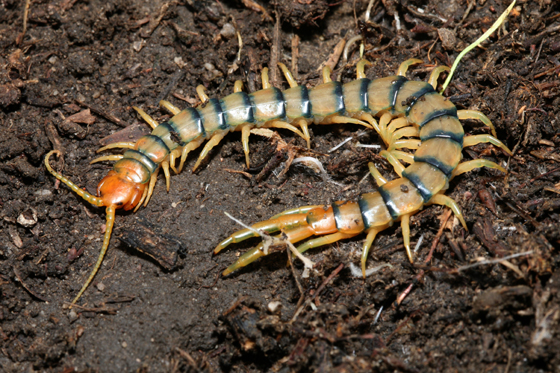


Scolopendra polymorpha, the common desert centipede, tiger centipede, banded desert centipede, or Sonoran Desert centipede, is indigenous to the Southwestern United States and northern Mexico, north to the Pacific coast. It inhabits dry grasslands, forest, and desert; in these habitats, the centipedes generally take up residence under rocks, though they have been observed creating burrows in suitable environments and inside rotting logs. Their bodies generally reach 4–7 in (10–18 cm) in length. Coloration is variable, hence the species name polymorpha which means "many forms", and alternative common names like "multicolored centipede". The body segments have one dark lateral stripe, so they are also known as the tiger centipede or tiger-striped centipede. Generally, this species has a darker brown-, red-, or orange-colored head and lighter brown, tan, or orange body segments with yellow legs. Its antennae have seven or more smooth segments.


source - Wikipedia

if u like the post please like and shear


Scolopendra subspinipes is a species of centipede. The native range is uncertain. The certain natural range is Meganesia and Indomalaya. The species is also found on virtually all land areas around and within the Indian Ocean, all of Tropical and Subtropical Asia (including Russia), South and Central America, and the Caribbean. However, how much of this range is natural and how much due to human introduction is unclear.

With such a wide geographic range, the species is known by a great many common names including Chinese Red Head, Giant Centipede, Jungle Centipede, Orange Legged Centipede, Red Headed Centipede and Vietnamese Centipede.

It is among the largest centipedes with a maximum length of 20 cm. They are active and aggressive, preying on almost everything that they can overwhelm.

Description

This is a large species which can grow up to 20 cm in length. It has colour variations. Its body is usually red or reddish brown with yellow or yellow-orange legs. In common with other members of genus Scolopendra, it has 21 body segments with each segment having one pair of legs attached. A pair of modified legs known as forcipules can be found on its head, which is covered by a flat shield and bears a pair of antennae. The forcipules are the major tools used by the centipede to kill its prey or for defense, as they have sharp claws that connect to venom glands. Centipedes breathe through the openings located along sides of their bodies. These openings are either round-shaped or S-shaped. They have simple eyes with poor vision, so they rely much on touch and their chemoreceptors.

Habitats

The species can be found in tropical and subtropical regions throughout the Old World. It is also one of only three species of centipedes in Hawaii.

Diet and behaviour

This is an aggressive and nervous arthropod which is ready to strike if interfered with and is sensitive to vibrations nearby. It preys primarily on insects or other predatory arthropods (like spiders), however, if it is large enough to overpower small vertebrates like mice or small reptiles, it will readily attempt to consume them as well. It tends to try to eat almost every living animal it encounters that is not longer than itself. It attacks its prey with the last prehensorial legs, then curves its head quickly behind to implant its venomous jaws deeply and firmly into the prey. The prey is held by the centipede's other legs until it dies from the fast-acting venom. During a fight, the centipede will use its entire body coiling the prey or enemy with its legs firmly attaching to the body of the opponent. Then, it will quickly penetrate its forcipules into the victim for venom injection.

The male produces capsules containing mature sperm cells, spermatophores, which are deposited in a reservoir called the spermathecae of the female during mating. The female then fertilizes her immature eggs, oocytes, and deposits them in a dark, protected area. The female lays 50 to 80 eggs which she vigilantly protects until they hatch and the baby centipede molt once. If danger is detected she will wrap around her babies to keep them safe. The young centipedes molt once each year, and take three to four years to attain full adult size. Adults molt once every year. They may live for 10 years or more.

Venom

Scolopendra subspinipes has been reported as the apparent cause of a human death. The fatal case was in Philippines in which the centipede bit a seven-year-old girl on her head. She died 29 hours later. There have been no other verifiable cases of centipede bite being implicated in human fatalities.

Scolopendra subspinipes mutilans

Scolopendra subspinipes japonica
Human uses

S. subspinipes is a popular pet among arthropod hobbyists. The centipede was a traditional food source for Aboriginal Australians

Subspecies

The number of subspecies of S. subspinipes is unclear and varies between authors. Taxonomic characters have incorporated plastic traits such as colour and sulcus structure and the number and position of spines, producing indistinguishable and intergrading subspecies. A 2012 review found that one former subspecies, S. subspinipes cingulatoides is in fact a distinct species, and that S. subspinipes has no valid subspecies.

source - Wikipedia

if u like the post please like and shear


Scolopendra viridicornis is a species of centipede in the family Scolopendridae that can be found on Indo-Burma border where its venom is used for medicine.

Medical use

The species is used to treat blood in stool, hematuria, chronic headache, anorexia, vaginal bleeding, and white vaginal discharge. Currently it is used to treat cancer in Manipur.


source - Wikipedia

if u like the post please like and shear


Scolopendra (through Latin from Greek σκολόπενδρα, skolopendra) is a genus of centipedes of the family Scolopendridae.

Description

In temperate climates, only relatively small species occur, but species from the tropics may exceed 30 cm (12 in).

One southeast Asian species, S. cataracta, is amphibious, and swims and walks underwater.

Ecology and venom

They are active predators, taking prey as large as rodents and even bats, but also small insects such as the stingless bee species Tetragonula iridipennis. Their bites are very painful, but are rarely fatal in humans. The venom is delivered through the animal's forcipules, which lie just behind the mandibles. The venoms of Scolopendra species contain compounds such as serotonin, haemolytic phospholipase A, a cardiotoxic protein, and a cytolysin.

Taxonomic history

Scolopendra was one of the genera created by Carl Linnaeus in his 1758 10th edition of Systema Naturae, the starting point for zoological nomenclature. Only two of the species originally assigned to the genus remain so: Scolopendra gigantea and S. morsitans; the latter was chosen to be the type species by Opinion 454 of the International Commission on Zoological Nomenclature, overruling a previous designation by Pierre André Latreille, in which he chose Linnaeus' Scolopendra forficata (now Lithobius forficatus) as the type species.

Species

The genus Scolopendra contains these species:

Scolopendra abnormis Lewis & Daszak, 1996
Scolopendra afer (Meinert, 1886)
Scolopendra algerina Newport, 1845
Scolopendra alternans Leach, 1813
Scolopendra andhrensis Jangi & Dass, 1984
Scolopendra angulata Newport, 1844
Scolopendra angusticollis Murray, 1887
Scolopendra anomia Newport, 1844
Scolopendra appendiculata Daday, 1891
Scolopendra arborea Lewis, 1982
Scolopendra arenicola (Lawrence, 1975)
Scolopendra arthrorhabdoides Ribaut, 1912
Scolopendra attemsi Lewis, Minelli & Shelley, 2006
Scolopendra aztecorum Verhoeff, 1934
Scolopendra calcarata Porat, 1876
Scolopendra canidens Newport, 1844
Scolopendra cataracta Siriwut, Edgecombe & Panha, 2016
Scolopendra childreni Newport, 1844
Scolopendra chlora Chamberlin, 1942
Scolopendra chlorotes C. L. Koch, 1856
Scolopendra cingulata Latreille, 1829
Scolopendra clavipes C. L. Koch, 1847
Scolopendra concolor Newport, 1845
Scolopendra crassa Templeton, 1846
Scolopendra cretica Attems, 1902
Scolopendra cribrifera Gervais, 1847
Scolopendra crudelis C. L. Koch, 1847
Scolopendra dalmatica C. L. Koch, 1847
Scolopendra ellorensis Jangi & Dass, 1984
Scolopendra fissispina L. Koch, 1865
Scolopendra foveolata Verhoeff, 1937
Scolopendra galapagoensis Bollman, 1889
Scolopendra gigantea Linnaeus, 1758
Scolopendra gracillima Attems, 1898
Scolopendra hardwickei Newport, 1844
Scolopendra hermosa Chamberlin, 1941
Scolopendra heros Girard, 1853
Scolopendra horrida C. L. Koch, 1847
Scolopendra inaequidens Gervais, 1847
Scolopendra indiae (Chamberlin, 1914)
Scolopendra indica Meinert, 1886
Scolopendra inermipes C. L. Koch, 1847
Scolopendra inermis Newport, 1845
Scolopendra jangii Khanna & Yadav, 1997
Scolopendra koreana (Verhoeff, 1934)
Scolopendra labiata C. L. Koch, 1863
Scolopendra laeta Haase, 1887
Scolopendra langi (Chamberlin, 1927)
Scolopendra latro Meinert, 1886
Scolopendra limicolor Wood, 1861
Scolopendra lucasii Gervais, 1847
Scolopendra lutea (Attems, 1928)
Scolopendra madagascariensis Attems, 1910
Scolopendra malkini Chamberlin, 1955
Scolopendra mazbii Gravely, 1912
Scolopendra media (Muralewicz, 1926)
Scolopendra melionii Lucas, 1853
Scolopendra metuenda Pocock, 1895
Scolopendra michoacana Chamberlin, 1941
Scolopendra mima Chamberlin, 1942
Scolopendra mirabilis (Porat, 1876)
Scolopendra monticola (Lawrence, 1975)
Scolopendra morsitans Linnaeus, 1758
Scolopendra multidens Newport, 1844
Scolopendra negrocapitis Zhang & Wang, 1999
Scolopendra nuda (Jangi & Dass, 1980)
Scolopendra occidentalis F. Meinert, 1886
Scolopendra octodentata Verhoeff, 1934
Scolopendra oraniensis Lucas, 1846
Scolopendra pachygnatha Pocock, 1895
Scolopendra paranuda (Khanna & Tripathi, 1987)
Scolopendra pentagramma Motschoulsky, 1886
Scolopendra pinguis Pocock, 1891
Scolopendra polymorpha Wood, 1861
Scolopendra pomacea C. L. Koch, 1847
Scolopendra puncticeps Wood, 1861
Scolopendra punensis Jangi & Dass, 1984
Scolopendra robusta Kraepelin, 1903
Scolopendra sanatillae Bollman, 1893
Scolopendra silhetensis Newport, 1845
Scolopendra spinipriva Bücherl, 1946
Scolopendra spinosissima Kraepelin, 1903
Scolopendra subspinipes Leach, 1815
Scolopendra sumichrasti Saussure, 1860
Scolopendra tenuitarsis Pocock, 1895
Scolopendra valida Lucas, 1840
Scolopendra violacea Fabricius, 1798
Scolopendra viridicornis Newport, 1844
Scolopendra viridipes Dufour, 1820
Scolopendra viridis Say, 1821
Scolopendra zuluana (Lawrence, 1958)

source - Wikipedia

if u like the post please like and shear


Scutigera coleoptrata – one of several species commonly known as the house centipede – is a typically yellowish-grey centipede with up to 15 pairs of legs. Originating in the Mediterranean region, the species has spread to other parts of the world, where it can live in human homes. It is an insectivore; it kills and eats other arthropods, such as insects and arachnids.

Morphology

The body of an adult Scutigera coleoptrata is 25 to 35 mm (0.98 to 1.38 in) in length. Up to 15 pairs of long legs are attached to the rigid body. Together with the antennae they give the centipede an appearance of being 75 to 100 mm (3 to 4 in) in length. The delicate legs enable it to reach surprising speeds of up to 0.4 meters per second (1.3 ft/s) running across floors, up walls and along ceilings. Its body is yellowish-grey and has three dark dorsal stripes running down its length; the legs also have dark stripes. S. coleoptrata has developed automimicry in that its tail-like hind legs present the appearance of antennae. When the centipede is at rest, it is not easy to tell its front from its back.

Unlike most other centipedes, house centipedes and their close relatives have well-developed faceted eyes.

Reproduction and development

House centipedes lay their eggs in spring. In a laboratory observation of 24 house centipedes, an average of 63 and a maximum of 151 eggs were laid. As with many other arthropods, the larvae look like miniature versions of the adult, albeit with fewer legs. Young centipedes have four pairs of legs when they are hatched. They gain a new pair with the first molting, and two pairs with each of their five subsequent moltings. Adults with 15 pairs of legs retain that number through three more molting stages (sequence 4-5-7-9-11-13-15-15-15-15 pairs).

House centipedes live anywhere from three to seven years, depending on the environment. They can start breeding in their third year. To begin mating, the male and female circle around each other. They initiate contact with their antennae. The male deposits his sperm on the ground and the female then uses it to fertilize her eggs.

Behavior and ecology

Closeup of the head showing modified legs
House centipedes feed on spiders, bed bugs, termites, cockroaches, silverfish, ants, and other household arthropods. They administer venom through modified legs (forcipules). These are not part of their mandibles, so strictly speaking they sting rather than bite. They are mostly nocturnal hunters. Despite their developed eyes, they seem to rely mostly on their antennae when hunting. Their antennae are sensitive to both smells and tactile information. They use both their mandibles and their legs for holding prey. This way they can deal with several small insects at the same time. To capture prey they either jump onto it or use their legs in a technique described as "lassoing". Using their legs to beat prey has also been described.

In a feeding study, S. coleoptrata showed the ability to distinguish between possible prey, avoiding dangerous insects. They also adapted their feeding pattern to the type of hazard the prey might pose to them. For wasps, they retreat after applying the venom to give it time to take effect. When the centipede is in danger of becoming prey itself, it can detach any legs that have become trapped. House centipedes have been observed to groom their legs by curling around and grooming them with their forcipules.

In 1902, C. L. Marlatt, an entomologist with the United States Department of Agriculture, wrote a brief description of the house centipede:

It may often be seen darting across floors with very great speed, occasionally stopping suddenly and remaining absolutely motionless, presently to resume its rapid movements, often darting directly at inmates of the house, particularly women, evidently with a desire to conceal itself beneath their dresses, and thus creating much consternation.

Habitat

Outdoors, house centipedes prefer to live in cool, damp places. Centipede respiratory systems do not provide any mechanism for shutting the spiracles, and that is why they need an environment that protects them from dehydration and excessive cold. Most live outside, primarily under large rocks, piles of wood, and especially in compost piles. Within the home, these centipedes are found in almost any part of the house. Most commonly they are encountered in basements, bathrooms, and lavatories, which tend to be humid, but they can also be found in drier places like offices, bedrooms and dining rooms. The greatest likelihood of encountering them is in spring, when they come out because the weather gets warmer, and in autumn/fall, when the cooling weather forces them to find shelter in human habitats.

Distribution

S. coleoptrata is indigenous to the Mediterranean region, but it has spread through much of Europe, Asia, North America and South America. It is thought to have first been introduced to the Americas in Mexico and Guatemala and now it reaches north into Canada and south to Argentina.

In the United States, it spread north from the southern states, reaching Pennsylvania in 1849, New York in 1885, and Massachusetts and Connecticut in about 1890. In 2009, its distribution extended from Virginia in the east to the coast of California in the west.

In 2011 it was sighted in Chile, in the Metropolitan and Los Lagos regions.

In South Africa, they have been found in the Western Cape, in and around Cape Town (sightings have been reported in Pinelands, Vredehoek, Mowbray, Edgemead, Green Point, Cape Town, Zonnebloem, Cape Town, Woodstock, Cape Town, Stellenbosch and Gordon's Bay) and also in KwaZulu-Natal, in the city of Pietermaritzburg. They are also found around the Garden Route, including but not limited to, Oudtshoorn, Mossel Bay, George and Knysna. They have also recently been found in Bloemfontein in the Free State.

In 2013 they have also been recorded in Lichinga (Mozambique) and Lujeri Tea Estate, Mulanje, Southern Malawi.

They have been found in eastern and southern Australia, from Perth to Adelaide, South Australia, to Sydney, New South Wales and in Tasmania. Other countries they have been found in include New Zealand, Japan, as well as South Korea.

Biological details

The faceted eyes of S. coleoptrata are sensitive to daylight as well as very sensitive to ultraviolet light. They were shown to be able visually to distinguish between different mutations of Drosophila melanogaster. How this ability fits with its nocturnal lifestyle and underground natural habitat is still under study. They do not instantly change direction when light is suddenly shone at them, but will retreat to a darker hiding spot.

Some of the plates covering the body segments fused and became smaller during the evolution to the current state of S. coleoptrata. The resulting mismatch between body segments and dorsal plates (tergites) is the cause for this centipede's rigid body.

Relation between body segments, dorsal plates (tergites), and leg pairs
Tergite 1 2 3 4 5 6 7 8 9 10 11
Segments 1 2 3, 4 5, 6 7, 8, 9 10, 11 12, 13 14, 15 16 17 18
(telson)
Leg pairs Forcipules 1 2, 3 4, 5 6, 7, 8 9, 10 11, 12 13, 14 15 (antenna-like snare legs) (gonopod) (anus)
Tergites 10 and 11 are not fully developed and segment 18 does not have a sternite. This model deviates from descriptions by Lewis who identified only 7 tergites and 15 segments.

Another feature that sets S. coleoptrata apart from other centipedes is that their hemolymph was found to contain proteins for transporting oxygen.

The mitochondrial genome of S. coleoptrata has been sequenced. This opened up discussions on the taxonomy and phylogeny of this and related species.

Interaction with humans

Unlike its shorter-legged but much larger tropical cousins, S. coleoptrata can live its entire life inside a building, usually the ground levels of homes. Though they often startle their unwitting housemates with their appearance and surprising speed, they are generally considered harmless to humans. Bites are uncommon, and the forcipules of house centipedes are not strong enough to easily penetrate human skin. Bites are similar to a bee's sting, with its venom causing redness and mild to severe swelling.

Techniques for eliminating centipedes from homes include drying up the areas where they thrive, eliminating large indoor insect populations, sealing cracks in the walls, and seeking the assistance of an exterminator.


source - Wikipedia

if u like the post please like and shear

Older Posts

Translate

About Me

My photo
Raj bhardwaj
View my complete profile

LET’S BE FRIENDS

Popular Posts

  • Names...ancient Assyria

Labels

amphipod Ancient world ants Bears Beetles Birds Bovidae family butterflies camelidae family cat breeds cat family centipedes Cervidae family copepod crabs crayfish crops crustacean dog breeds dogs family ( canidae ) Elephantinae family flies flowers frogs fruits fungus and mushrooms gnathiidae grasses and herbage herbs and remedy indian states & union territories isopods krills lemore ( Lorisidae ) lobsters millipedes monkeys moths ( polyphyletic group ) Nature wonders and phenomenas pet birds pig family plankton plants platypus Rhinocerotidae family rodents scorpion shrimp spices spiders toads tourism places in India trees universe virus water fleas weasel family ( nevala ) woodlouse world geography world history

recent posts

Blog Archive

  • February (29)
  • March (30)
  • February (1142)
  • February (136)
  • January (125)
  • November (168)

Created with by BeautyTemplates | Distributed by blogger templates