youtube facebook twitter linkedin
the book of earth. Powered by Blogger.

Pages

  • Home

The book of earth


Classification
Kingdom : Animalia
Phylum : Chordata
Class: Mammalia
Order : Artiodactyla
Family : Cervidae
Genus : Cervus
Species : C. duvaucelii
Zoological name : Cervus duvaucelii
Found In Kaziranga, Kanha, Dudhwa and Manas National Park
Physical appearance : Barasingha stands up to 130 cm and weigh around 170- 180 kg. It is a medium size deer. It is dense brown in colour. It's underparts are white in colour. Male antlers are up to 75 cm long and can have more than 12 points. It has high legs, short head and long broad ears. They have long and broad hooves. They have log hairs around its neck. It coat becomes darker during the mating season.
Presence in India : Barasingha is mostly found in North India, Central India and North East India. They are widely spotted in the
Kaziranga , Kanha, Dudhwa and Manas National Park. They can also be located throughout the basins of the Indus, Ganges and Brahmaputra river.
Habitat : Barasingha prefers moist forest, swamplands, tall grass and reed beds near water.
Diet : Barasingha are herbivorous. They feed om aquatic plants, leaves,and grasses. It drinks atleast twice a day during the summer season.
Sub-species of Barasingha : Wetland barasingha (Cervus duvaucelii duvaucelii), upland barasingha (C. d. branderi), C. d. ranjitsinhi
Reproduction : Barasingha usually breeds during the month of November and December. Gestation period rests for 240 -250 days after which the female gives give birth to one or two young. They reach the level of sexual maturity at 2 years of age. Males turn dark during the breeding season. Only the dominated males (those who wins the fights) get the chance to mate with the females. Breeding herds are mixed of males, females and does. Herds mainly consists of 20-30 members.
Conservation status : Classified as Vulnerable (VU C1) on the IUCN Red List 2002, and listed on Appendix I of CITES. The destruction of their habitat due to deforestation has seriously declined the population of Barasingha. They are being haunted for their horns.
Lifespan : Barasingha lives up to 23 years of age.


if u like the post please like and shear
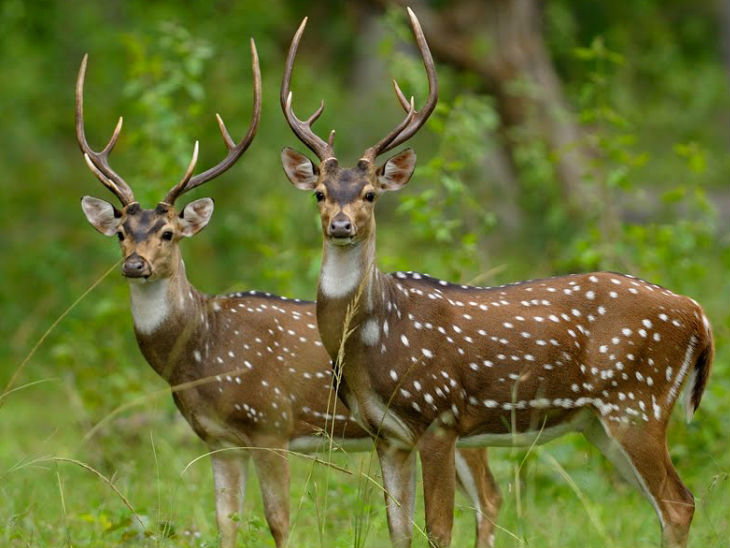


Classification
Kingdom : Animalia
Phylum : Chordata
Class: Mammalia
Order : Artiodactyla
Family : Cervidae
Subfamily : Cervinae
Genus : Axis
Species : A. axis
Zoological name : Axis axis

Found In : Corbett National park, Kanha National Park, Bandhavgarh National Park and Sariska Tiger Reserve

Physical appearance : Chital are 90 cm tall and weigh up to 85 kg. Its upper parts are reddish fawn and the under parts are white in colour. It has white spots all over the body. Antlers are present in males only that may exceed up to 75 cm. They shed them anually. Their antlers have six point plan. They are tuned back into the upward curve and have three points each. These antlers are used in mating displays and for the purpose of protection. They have white patch on the throat. They have a black dorsal stripe that run down their backs. They are good swimmers.
Presence in India : They are easily found in the jungles of India. They are easily spotted in the wild parks of India such as Corbett, Kanha, Dudhwa, Bandhavgarh, Mudumalai, Sariska.
Habitat : Chital prefers terrestrial, woodland, forests and clearings near water ways. They are usually found in the herds of 10 - 20 individuals.
Diet : Chital mainly feeds on grasses and browsed vegetation. They also favours wheat, fruits, herbs, flowers and leaves. They feed for four hours after sunrise and for two hours before sunset.
Reproduction : Chital reach the sexual maturity at 12 -14 months. Gestation lasts for seven months. Mating season of the Cheetal or Axis Deer varies geographically. Estrus in females occur throughout the year. Females give birth to one to three fawns. Fawns are born throughout the year. Young ones are weaned at 6 months.
Conservation status : Not threatened. Deforestation and loss of habitat has seriously declined the population of Chital. They are widely haunted for games. Their main threats are wild dogs and leopards.
Lifespan : Lifespan of the Chital is around 20 -30 years.


if u like the post please like and shear


Classification
Kingdom : Animalia
Phylum : Chordata
Class: Mammalia
Order : Artiodactyla
Suborder : Ruminantia
Family : Cervidae
Subfamily: Cervinae
Genus : Cervus
Species: C. unicolor
Zoological name : Cervus unicolor
Found In : Kanha, Corbett, Ranthambore, Bandhavgarh, Gir, Dudhwa, Manas, Kaziranga National Park in India
Physical appearance : Sambar deed stands to a height of 135 -150 cm at the shoulder and can weigh up to 300 kg. Males have antlers measuring up to 1m. Its coat is dark brown in colour. It is characterized with large muzzle and broad ears. It has tick fur and orange spots on its body. Males are larger than the females. Its tail is 22- 35 cm long. Males have thick mane of hairs around the neck.
Presence in India : Sambar deer is found in almost every corner of India, But it is mainly found in the central India. They can easily be spotted at Kanha, Corbett, Ranthambore, Bandhavgarh, Gir, Dudhwa, Manas, Kaziranga and Sariska.
Habitat : Sambar Deer prefers marshy and wooded areas to live.
Diet : Sambar deer feeds on leaves, vegetation, herbs, fruit, bamboo buds and mushrooms.
Reproduction : The breeding period is mainly during the months of November and December. The gestation period rests for almost 6 months after which single offspring is born. The young ones are weaned at about 7 months of age.
Conservation status : Least concern
Lifespan : The life expectancy of Sambar Deer exceeds up to 16 -20 years of age.
« Eco Parks
- Bandhavgarh National Park
- Bharatpur Bird Sanctuary
- Corbett National Park
- Kaziranga National Park
- Periyar Wildlife Sanctuary
- Ranthambore Wildlife
more...
« Eco Wonders
« Eco Adventure/Activities
- Ayurveda
- Camel Safari
- Meditation
- Mountain Expeditions
- White Water Rafting
- Yoga
more.....
« Eco Tours
- Best of Sikkim
- Desert Safari Tour Rajasthan
- Ganges River Rafting
- Kerala Houseboat Vacation
- Wildlife Tour in India
more.....
« Eco Places
- Goa
- Himalayas
- Kerala
- Sikkim
more.....
« Home Stays
- Elephant Valley Hotel
- Gramam Homestay
- Hermitage Guest House
- Kannankeril Homestay
- Kerala Village Homestay
- Our Native Village
- The Bungalow
« Flora & Fuana
Animals
- Mammals
- Birds
Flora
- Trees
- Flowers


if u like the post please like and shear

Older Posts

Translate

About Me

My photo
Raj bhardwaj
View my complete profile

LET’S BE FRIENDS

Popular Posts

  • Mongolian toad

Labels

amphipod Ancient world ants Bears Beetles Birds Bovidae family butterflies camelidae family cat breeds cat family centipedes Cervidae family copepod crabs crayfish crops crustacean dog breeds dogs family ( canidae ) Elephantinae family flies flowers frogs fruits fungus and mushrooms gnathiidae grasses and herbage herbs and remedy indian states & union territories isopods krills lemore ( Lorisidae ) lobsters millipedes monkeys moths ( polyphyletic group ) Nature wonders and phenomenas pet birds pig family plankton plants platypus Rhinocerotidae family rodents scorpion shrimp spices spiders toads tourism places in India trees universe virus water fleas weasel family ( nevala ) woodlouse world geography world history

recent posts

Blog Archive

  • February (29)
  • March (30)
  • February (1142)
  • February (136)
  • January (125)
  • November (168)

Created with by BeautyTemplates | Distributed by blogger templates